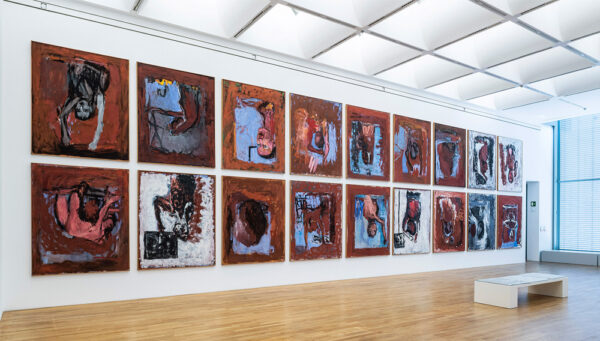
To mark the 25th anniversary of his death, Kunstmuseum Bonn is dedicating a room within its presentation of the collection to Douglas Swan. The focus is on the works from his Bonn years, supplemented by archive material and accounts of the art scene at the time. The presentation is organised in collaboration with the Douglas Swan Foundation. In addition to works from the collection of the Kunstmuseum Bonn, selected works from the artist’s estate will also be on display.
The life and work of Scottish painter Douglas Swan (1930–2000) are closely linked to the city of Bonn: He lived here from the mid-1970s, was part of the local art scene and drew inspiration from the city’s art and music history. The years in Bonn marked the high point of his artistic career.
Douglas Swan used painting as a perspective on reality. He explored everyday motifs, such as chairs, painting palettes or Bonn Palace, by repeating, varying and fragmenting them: “I am interested in the double life of visual phenomena; the same object, seen in different ways…”, says Swan. Not only the people, places and art history of Bonn – such as the influence of August Macke – flowed into his works. Swan was also enthusiastic about classical music and transferred its structures into his paintings. Swan’s works defy fixed stylistic categories. Balancing gestural abstraction and figurative echoes to create a highly individual visual language.
Douglas Swan was born in Connecticut (USA) in 1930 and grew up in Scotland. He studied at Dundee College of Art and received several scholarships. He moved to Germany in the 1960s, but returned to his Scottish homeland time and again. He lived in Bonn from 1976 until his death in 2000.